I often say that I am confused by life, and by that I don't mean stymied, as by GRE vocabulary. I mean that I "go after my life with a a broad-axe," which is what Annie Dillard says writers must do to themselves.
By tender-hearted people in aloof moments, I am asked why I do that, because doesn't it hurt?, and I wish I could explain in words, but answering that would be like defining love, or questioning a tower about gravity as it falls.
Then something happens viscerally and I know exactly how to answer.
Last night I came back from a Saturday and Sunday of camping, biking, and barbecues, after a Friday of passing out food and hygiene products to the chronically homeless, ended with a night of salsa dancing. I was tired, swollen with the pendulum of things. My eyes were red and my mind damp.
It was 10:30pm when I pulled in front of our corner house and heard our early-20-something neighbors on the porch. I've noticed them often. I'm a little older, but I find them attractive, in a distant way. They smoke and drink an array throughout the day. After work and school, they play drums and guitar late into the night, then finish their waking hours with thin women, Nintendo Wii, and revelry on the porch. They laugh a lot, and talk philosophy. I don't much like their smell. I do like their spirit.
They're at it again, and power to them, I thought, and began emptying camping gear from my car. The temptation of bed, of turning everything off, doubled the weight of the task. Then I heard the rumbling of a shopping cart turn onto our avenue. We live on the corner of a busy street on the edge of northern Portland, a highly gentrified zone where vegan cafes and social services agencies are equally myriad. We live two blocks from The Salvation Army.
Black face, black hat, black coat, black night. Cart full of blankets and plastic. She hummed as she passed my house, and I caught myself wondering if she were high or mentally ill. "Hello," I said. The word came out bubbly, earnestly. "Hello," she replied, with equal legitimacy.
She kept walking, so I kept living. She turned her cart up the cement walkway of the house next door. Avoiding blatant gawking, I saw her rummage through the bins below the white party porch, searching for bottles to turn in for refunds at Fred Meyer.
Above her, they were as gloriously high as she might have been. No one acknowledged her.
The rummaging through their glass beer bottles lasted two minutes, I counted, accompanied by persistent humming by a black woman in a black hat and black coat, below a white porch of white people in white light. The confluence was plangent enough in my head and in the air to wake the baby two houses down. But the philosophical murmurings on the porch next door never ended. The thin women and young man with a brew never turned around to see her. He finished his beer and put the empty bottle on the porch, awaiting the moment when he could chuck it over the bannister into the bin below, without hitting a woman in the nose.
They never turned around to see her.
Our culture is vague perplexing, our language perhaps more so. What is meant by "see"? Had they defied all societal boundaries by making their way down the porch steps, complimenting her on her glorious humming, offering her the last of their expensive beer bottles with a humble apology, along with a joint to numb her reality alongside theirs, a plate of food, a shower, and then progressing with their God-given prerogatives, would that count, as seeing? Or perhaps seeing means "going after your life with a broad-axe," and once seeing her, they'd never be able to play Wii (the same way?) again.
The woman didn't much seem to notice their neglect. I did. "Hey, do you see what's going on? Can you do something about this?" Said the voice in my conscience, to their souls, silently. But I stayed quiet. I carried my guitar and tent into my basement room, and I began to write this. I hope it counts.
I want to believe that the whole world
Is my home, the field I sow,
And that all reap what all have sown.
I will not believe that I can combat oppression out there
If I tolerate injustice here.
I want to believe that what is right
Is the same here and there
And that I will not be free
While even one human being is excluded.

Monday, May 26, 2014

Tuesday, April 22, 2014
Global Solidarity Checklist Part II: A Treatise on the Disastrously Unnecessary
Allow me to acknowledge we all have different comfort levels and definitions of "necessity," and that by arguing that the following items which are commonplace in our society are largely pointless, I am not trying to imply that you are me (how unfortunate for you) and have the same psychological and physical thresholds.
Rather, I am trying to start a conversation, beginning with what I know that I don't need, and why, and hoping you'll consider your own list. Also I'm trying to make you think, and laugh.
Without further ado, in honor of Earth Day, and in increasingly improbable order, here's a list of gizmos I have learned to live without, and what I use to replace them.
Tissue (Kleenex®): They're scratchy, too thin (don't your fingers get goopy when you use them?), and despite best efforts to used recycled components, ecologically unstable. Alternative: handkerchief.
Plastic grocery bags: Have you heard about Trash Island? Twice the size of Texas? Portland's doing just fine without these mindless conveniences. Alternative: canvas bags, and instead of supermarkets, farmers' markets!
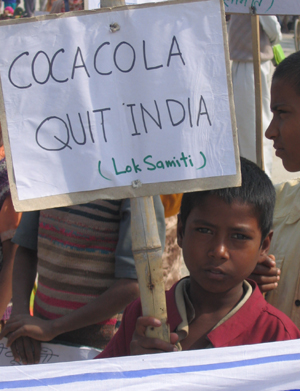
Soda: I love this image of a struggling campaign in India. Our sisters and brothers in the developing world, and our children with increasing rates of diabetes and ADHD, know the truth better than we do--that we can learn to go without this luxury. In the meantime, know that an eighth grade classmate of mine left a baby tooth of hers in a glass of Coca-Cola for two weeks. By the end of the two weeks, PRESTO! No baby tooth. The tooth fairy must have gone corn-syrup diving. Alternative: for sugar and caffeine purposes, fresh fruit juice and fair trade coffee. Mixed together, of course.
Hair Dryers: The one thing I am vain about is my hair (and maybe the size and origin of my earrings). Beyond the obvious environmental laughability, these contraptions are amusing because they're more accurately called hair fryers. Alternative: sleep in.
Diamond Rings: I used to dream that the right man would semi-prostrate himself before me and present me with a rainbow rock. Then I watched Leonardo DiCaprio and Djimon Hounsou and did my own digging and discovered that most diamonds (and precious minerals in general) are mined by child slaves amid toxic fumes. Not to fear! Some of my recently-married friends have made both my day and serious fashion statements by foregoing the bloody bling. Alternative: a diamondless wedding (yep, I'm a cheap long-term date), or fairly-sourced diamonds and minerals.
Bottled Water: Do your own research (you could start here), but I've found that not only is it quite disastrous to the planet (and thus disastrous to our survival in the long-run), it's not better for personal health. Alternative: perpetual thirst. Just kidding, reusable bottle.
Gymnasiums: Machines were invented to reduce personal energy expenditures. And now we're plugging machines in to facilitate this process? Alternatives: bikes, jogs, dancing, and new gyms where workouts power the building.
Televisions: Phones and computers, however ecologically and socially questionable, I can understand. But when did we fall asleep to pumping conflict minerals and fossil fuels into our nation's preferred at-rest activity? My alternatives: books, music, dance, the outdoors, and if you must, the internet. What are your alternatives?
Showers: During Lent, I confined myself to Alternative: baths and bucket-showers. Not only did they slow me down and calm me, they were remarkably easily to integrate into my daily routine. And in a world where a 2-minute daily shower is more than the average human being has access to in a month (more info here), such a compromise seems more than fair.
Clothes Dryers: Those of us who live in places that are warm, dry or windy during any part of the year have even less of an excuse. Alternative: Buy a wooden drying rack. Money and planet saved simultaneously. Just make sure the neighbors don't see your mom's bloomers parading on the breeze, or she'll smack you (you live and learn).
Flushing Toilets: Really? All this press about water shortages and we're using clean drinking water to send our feces on a lazy river ride? Alternative: revenge on your neighborhood enemies' front lawns, or here's a better one.
Other cool things to check out:
A cheaper, healthier, more sustainable alternative to pads and tampons (sorry, fellas, the next one will be less invasive to you)
The King of Sustainability in Hollywood
Why I Own A Dumb Phone: 7 Frightening Statistics about Cell Phones
I'm doubting this list will inspire you to yank out your porcelain throne and dig a hole under it. But perhaps you could turn off the computer for a bit and take a walk in the breeze. Now that I've spent an undisclosed number of hours staring at this screen, I think I'll do just that. Enjoy your Earth today. It's thanks to Her you're alive.
Rather, I am trying to start a conversation, beginning with what I know that I don't need, and why, and hoping you'll consider your own list. Also I'm trying to make you think, and laugh.
Without further ado, in honor of Earth Day, and in increasingly improbable order, here's a list of gizmos I have learned to live without, and what I use to replace them.
Tissue (Kleenex®): They're scratchy, too thin (don't your fingers get goopy when you use them?), and despite best efforts to used recycled components, ecologically unstable. Alternative: handkerchief.
Plastic grocery bags: Have you heard about Trash Island? Twice the size of Texas? Portland's doing just fine without these mindless conveniences. Alternative: canvas bags, and instead of supermarkets, farmers' markets!
Soda: I love this image of a struggling campaign in India. Our sisters and brothers in the developing world, and our children with increasing rates of diabetes and ADHD, know the truth better than we do--that we can learn to go without this luxury. In the meantime, know that an eighth grade classmate of mine left a baby tooth of hers in a glass of Coca-Cola for two weeks. By the end of the two weeks, PRESTO! No baby tooth. The tooth fairy must have gone corn-syrup diving. Alternative: for sugar and caffeine purposes, fresh fruit juice and fair trade coffee. Mixed together, of course.
Hair Dryers: The one thing I am vain about is my hair (and maybe the size and origin of my earrings). Beyond the obvious environmental laughability, these contraptions are amusing because they're more accurately called hair fryers. Alternative: sleep in.
Diamond Rings: I used to dream that the right man would semi-prostrate himself before me and present me with a rainbow rock. Then I watched Leonardo DiCaprio and Djimon Hounsou and did my own digging and discovered that most diamonds (and precious minerals in general) are mined by child slaves amid toxic fumes. Not to fear! Some of my recently-married friends have made both my day and serious fashion statements by foregoing the bloody bling. Alternative: a diamondless wedding (yep, I'm a cheap long-term date), or fairly-sourced diamonds and minerals.
Bottled Water: Do your own research (you could start here), but I've found that not only is it quite disastrous to the planet (and thus disastrous to our survival in the long-run), it's not better for personal health. Alternative: perpetual thirst. Just kidding, reusable bottle.
Gymnasiums: Machines were invented to reduce personal energy expenditures. And now we're plugging machines in to facilitate this process? Alternatives: bikes, jogs, dancing, and new gyms where workouts power the building.
Televisions: Phones and computers, however ecologically and socially questionable, I can understand. But when did we fall asleep to pumping conflict minerals and fossil fuels into our nation's preferred at-rest activity? My alternatives: books, music, dance, the outdoors, and if you must, the internet. What are your alternatives?
Showers: During Lent, I confined myself to Alternative: baths and bucket-showers. Not only did they slow me down and calm me, they were remarkably easily to integrate into my daily routine. And in a world where a 2-minute daily shower is more than the average human being has access to in a month (more info here), such a compromise seems more than fair.
Clothes Dryers: Those of us who live in places that are warm, dry or windy during any part of the year have even less of an excuse. Alternative: Buy a wooden drying rack. Money and planet saved simultaneously. Just make sure the neighbors don't see your mom's bloomers parading on the breeze, or she'll smack you (you live and learn).
Flushing Toilets: Really? All this press about water shortages and we're using clean drinking water to send our feces on a lazy river ride? Alternative: revenge on your neighborhood enemies' front lawns, or here's a better one.
Other cool things to check out:
A cheaper, healthier, more sustainable alternative to pads and tampons (sorry, fellas, the next one will be less invasive to you)
The King of Sustainability in Hollywood
Why I Own A Dumb Phone: 7 Frightening Statistics about Cell Phones
I'm doubting this list will inspire you to yank out your porcelain throne and dig a hole under it. But perhaps you could turn off the computer for a bit and take a walk in the breeze. Now that I've spent an undisclosed number of hours staring at this screen, I think I'll do just that. Enjoy your Earth today. It's thanks to Her you're alive.
Saturday, March 29, 2014
Chang in the City of Angels
I met Chang at the Hippie Kitchen in LA, when I was complaining. I was cutting onions after watering a littered garden for an hour. Distracted by my soiled pants, I had noticed but not engaged this peaceful-faced man with round glasses and a humble, healthy build. Tears invoked by the pungent air and my yawning trickled onto the bustling chopping board in front of me. Extra-salty salad. “Damn eyes. Impossible to work at full capacity when you’re tired and chopping onions,” I remarked to the company. Giggles of agreement.
“Heather, this is Chang. He’s new and volunteering this morning. Can you show him around?”
“Hey, Chang, you from around here?”
“I was from Seoul. Now I am from the Row.”
Like single mothers with five children who work two jobs, and war veterans who work for peace, volunteers at the soup kitchen who live on Skid Row bruise hearts because they defy impossibility, because their lucidity and energy within a circle of well-rested, reluctantly uncomfortable servers transcends the chaos of their circumstances.
Chang studied theology at a premiere Christian university in South Korea. A man of intellectual and fiercely genuine compassion, he fulfilled a dream to leave his home for Los Angeles, the City of Angels, with the intention of living not for the homeless, but with them.
He planted his pack in the Row, amid concrete slabs staked out with hastily scribbled cardboard signs, next to plastic bags that had become tents: “Jaynie’s Turf.” “Not Abandoned—Do Not Remove Belongings.” “Residence of Dutch and Tara Brown.” Chang dragged through his first night serenaded by drug sales and the uninhibited cackle-screams of destitute sleeplessness.
Though it can’t be said he woke up, because he never went to sleep, he marked the beginning of the next day by walking a few blocks to the first tendrils of LA gentrification. Third Street, where new and relentless $2,000 lofts and boulangeries wince at crumbling social services on sewage-stained sidewalks, fogs the senses. Chang, having just eaten his fill at the Hippie Kitchen, sat down on the concrete far enough from an up-and-coming cafe not to bother the customers, and began to observe. He observed hungry black men with permanently angled faces shaking their cups asking for change, while young white and Asian folks gazed elsewhere as they passed. In their hands, five, ten, sixteen ice-blended drinks, he counted. Sixteen. Each worth $5-6. That feeds how many families at home? Don’t they know someone sees them? They say they don’t give money because he might buy drugs. But I’d rather a poor man buy drugs to appease his terrors than a rich man buy a coffee to pass the time.
Chang didn’t stay in LA very long. He was headed back to Korea for the birth of a nephew. On his final night, he came to mass and potluck at the Catholic Worker. During a period of open praying for the world, I heard him mumble through tears.
“When I first came to the City of Angels, I saw only pain. But here at this house, I have found angels.”
Tuesday, December 24, 2013
An Adult Child's Christmas Story
When I was little, my favorite books were of the epic fantastical sort. A Wrinkle in Time was my favorite. Meg, a frumpy redheaded pre-teen with glasses and braces and without friends, crosses the galaxy through a space-time fold called a tesseract with a heart-throb classmate named Calvin who loves her for her personality (HA), to rescue her father and brother through the power of love from a robot-brain called IT that has brainwashed an entire planet. I also liked The Dark is Rising series. Will, a quiet and misunderstood ten-year-old, discovers he is the last in an ancient line of guardians-against-the-Dark destined to hasten the coming of the Pendragon, the heir of King Arthur.
I remember a baby-sitter telling the me who read these books, "I don't read much about magic. There's enough magic in life."
Adults are absurdly boring and confused.
Then I learned to dance, climbed mountains, lived in Nicaragua, fell in love, had my heart broken and remade, traveled, re-examined faith, did a million other privileged things, and I began to understand a fraction of what she might have meant.
I believe the search for magic, for a spark up the spine, a miraculous power emanating from the fingertips to pierce the fog of pain and routine, is integral to the human being, particularly to those who live in a world of banks, computers, highways, supermarkets, and shall I say, disconnection.
It's a search reborn at Christmas, particularly the consumerist secular Christmas, embodied by a Saint with twinkling eyes wrapped in a bright red scarlet suit who carries joy in toy-shaped boxes over electric roofs to wealthier innocents.
This holiday season I have found myself with a day-to-day routine that involves laptop-pecking and supporting my family through difficult times. So last night, noticing it was the day before Christmas Eve, I told myself I would go search for Christmas magic.
My mind's eye responded instantaneously that I should head for the bridges. Portland is sometimes called the Bridge City for the six or seven spectacular bridges that cross the Willamette River and unite the downtown side with the residential/hippie side. In the dark the rainbow lights of sky-scrapers wake up and ricochet off the steel and water, turning the whole city into a night sky. There's no better place to appreciate Christmas lights than Portland, year-round.
And so, grateful for my independence, for the chance to escape, and for one SERIOUSLY legit road bike my mom bought for a trip down the California coast with my triathlete Dad in their twenties, I headed to the bridges.
My first stop was Burnside Bridge, site of the famous Portland, Oregon reindeer sign, which I had never paused to appreciate. This laser billboard flashes for the Weird City all year long, and it's rare to pass a night without a tourist's camera blocking the sidewalk waiting for both words to light up. That was me last night, but my hands were shaky from the ride, so I asked the first people who passed me if they would take the picture. They were a hand-holding couple with cigarettes and skinny jeans. The first guy said, "Oh, no problem," with an understanding drawl. He snapped the following shot.

I stopped my bike. Across the street outside Portland Rescue Mission, I counted count one hundred and sixteen souls in line, sleeping on cardboard, embracing each other with oily down coats, hiding from the cold and waiting for some holiday cheer. Oregon has one of the country's highest homeless populations. One hundred and sixteen.
"Hey, f---er!" Screamed a young fellow with a frayed purple hat, "If you're gonna stop and stare, at least turn that f---ing headlight off!" My bike light has the wattage of a police car siren.
I woke up and realized I was more visible than I had imagined, attempted a loud laughing SORRY to relieve tension, then biked away toward Broadway Bridge. Along the way, I counted at least ten more souls on cardboard.
The downtown streets were relatively empty; I venture the yuppie population had gone home to their parents in suburbia, leaving the road open and quiet, so I could breathe, listen, notice things I hadn't before. Such as, at the base of every magical bridge, there is a sign that says, "24-hour Suicide Hotline."
On Broadway Bridge I was alone for a good four minutes. Alone on a steel ligament over water and between worlds. City on all sides of me and I heard no noise. Gazing along the River, I caught a cream-colored ferryboat pick up late night tourists along the Willamette half a mile away. Its sides were slick with the tiniest lights. I could make out a group dancing around a banjo and a young man chasing an overly-jacketed toddler.
I usually take a busy thoroughfare called MLK Jr Blvd north to my house, but my bike gears were acting up, and not wanting to risk any proximity with cars, I disobeyed my mothers' relentless warnings and took dark streets home. Christmas lights are intensified in the fog. The mansions and cottages of Irvington district in Southeast were decorated in scarlet made-in-China bows and wreaths I could smell from the street. Through the windows I saw storybook preparations for Christmas feasts.
I passed the tail end of a Cadillac warehouse and counted sixty Escalades through jail barred-windows. Despite myself, I began fantasizing about how a Christmas wish of mine would be to dance amid them with a Louisville slugger and spray paint.
And below one window was a man with a face covered by matted black hair, setting up a sleeping bag. He spun when he saw my obnoxious bike light. "Goddamn, lady, I thought you were the cops!" He laughed. "Merry Christmas."
Merry Christmas to you, too, I choked. I don't trust myself alone with men I don't know, so instead of doing the compassionate thing and stopping to talk to him, I continued on my less-than-Merry way.
The ride back to the house from near downtown is all uphill, so I whistled in relief when I reached the porch, huffing, reeling, incredulous at the unexpected gifts and challenges of the night. Maybe Meg and Will from those books felt something similar when they went to sleep after crossing galaxies and facing robed demons.
I remember a philosophy teacher in college who told us all he had a stupid stick. After learning about Socrates' allegory of the cave, he told us he could tap each of us on the head with this stick and transform us into dunces. Is ignorance bliss? Would we accept his offer? I have felt tempted before, to sleep through life. It would hurt less. But then there would be no whistling after bike rides.
Here's a snippet from the book I'm reading right now, called The Brothers Karamazov, called by some the greatest novel ever written.
I remember a baby-sitter telling the me who read these books, "I don't read much about magic. There's enough magic in life."
Adults are absurdly boring and confused.
Then I learned to dance, climbed mountains, lived in Nicaragua, fell in love, had my heart broken and remade, traveled, re-examined faith, did a million other privileged things, and I began to understand a fraction of what she might have meant.
I believe the search for magic, for a spark up the spine, a miraculous power emanating from the fingertips to pierce the fog of pain and routine, is integral to the human being, particularly to those who live in a world of banks, computers, highways, supermarkets, and shall I say, disconnection.
It's a search reborn at Christmas, particularly the consumerist secular Christmas, embodied by a Saint with twinkling eyes wrapped in a bright red scarlet suit who carries joy in toy-shaped boxes over electric roofs to wealthier innocents.
This holiday season I have found myself with a day-to-day routine that involves laptop-pecking and supporting my family through difficult times. So last night, noticing it was the day before Christmas Eve, I told myself I would go search for Christmas magic.
My mind's eye responded instantaneously that I should head for the bridges. Portland is sometimes called the Bridge City for the six or seven spectacular bridges that cross the Willamette River and unite the downtown side with the residential/hippie side. In the dark the rainbow lights of sky-scrapers wake up and ricochet off the steel and water, turning the whole city into a night sky. There's no better place to appreciate Christmas lights than Portland, year-round.
And so, grateful for my independence, for the chance to escape, and for one SERIOUSLY legit road bike my mom bought for a trip down the California coast with my triathlete Dad in their twenties, I headed to the bridges.
My first stop was Burnside Bridge, site of the famous Portland, Oregon reindeer sign, which I had never paused to appreciate. This laser billboard flashes for the Weird City all year long, and it's rare to pass a night without a tourist's camera blocking the sidewalk waiting for both words to light up. That was me last night, but my hands were shaky from the ride, so I asked the first people who passed me if they would take the picture. They were a hand-holding couple with cigarettes and skinny jeans. The first guy said, "Oh, no problem," with an understanding drawl. He snapped the following shot.

I thanked him and prepared to leave, when I realized he was still snapping away, browsing through my camera's nightlight settings. "I'm not satisfied with the angle I got, and the lights are a little blurry," he said. Amused, I allowed him to keep playing, when I heard his boyfriend heave a monstrous sigh.
"I'm a native Oregonian," said the second guy (how native, I wondered, since he looked like me) "and this sign is a total lie. It used to say WHITE STAG, then all the Californians showed up (guilty, I thought) and they changed it to say MADE IN OREGON for a local factory, and about ten years ago Portland became a hot spot and now it's our tacky claim to fame. I never understand why everyone wants a picture with it."
"Don't listen to him," said the first guy, handing me my camera, "he's impatient because we're on our way to have sex." They both wished me a Merry Christmas as I biked away guffawing, stripped of all pretext.
I headed west on the Bridge into Old Town Portland, below the famous sign. Lantern were draped with lights, Christmas trees squatted outside mildewed windows through which dreadlocked men and women methodically mimed. I began entering a dreamy Christmas state again, when I realized I had hit the corner of Burnside and Broadway. The epicenter of Downtown Portland's homeless population.
"Hey, f---er!" Screamed a young fellow with a frayed purple hat, "If you're gonna stop and stare, at least turn that f---ing headlight off!" My bike light has the wattage of a police car siren.
I woke up and realized I was more visible than I had imagined, attempted a loud laughing SORRY to relieve tension, then biked away toward Broadway Bridge. Along the way, I counted at least ten more souls on cardboard.
The downtown streets were relatively empty; I venture the yuppie population had gone home to their parents in suburbia, leaving the road open and quiet, so I could breathe, listen, notice things I hadn't before. Such as, at the base of every magical bridge, there is a sign that says, "24-hour Suicide Hotline."
On Broadway Bridge I was alone for a good four minutes. Alone on a steel ligament over water and between worlds. City on all sides of me and I heard no noise. Gazing along the River, I caught a cream-colored ferryboat pick up late night tourists along the Willamette half a mile away. Its sides were slick with the tiniest lights. I could make out a group dancing around a banjo and a young man chasing an overly-jacketed toddler.
I usually take a busy thoroughfare called MLK Jr Blvd north to my house, but my bike gears were acting up, and not wanting to risk any proximity with cars, I disobeyed my mothers' relentless warnings and took dark streets home. Christmas lights are intensified in the fog. The mansions and cottages of Irvington district in Southeast were decorated in scarlet made-in-China bows and wreaths I could smell from the street. Through the windows I saw storybook preparations for Christmas feasts.
I passed the tail end of a Cadillac warehouse and counted sixty Escalades through jail barred-windows. Despite myself, I began fantasizing about how a Christmas wish of mine would be to dance amid them with a Louisville slugger and spray paint.
And below one window was a man with a face covered by matted black hair, setting up a sleeping bag. He spun when he saw my obnoxious bike light. "Goddamn, lady, I thought you were the cops!" He laughed. "Merry Christmas."
Merry Christmas to you, too, I choked. I don't trust myself alone with men I don't know, so instead of doing the compassionate thing and stopping to talk to him, I continued on my less-than-Merry way.
The ride back to the house from near downtown is all uphill, so I whistled in relief when I reached the porch, huffing, reeling, incredulous at the unexpected gifts and challenges of the night. Maybe Meg and Will from those books felt something similar when they went to sleep after crossing galaxies and facing robed demons.
I remember a philosophy teacher in college who told us all he had a stupid stick. After learning about Socrates' allegory of the cave, he told us he could tap each of us on the head with this stick and transform us into dunces. Is ignorance bliss? Would we accept his offer? I have felt tempted before, to sleep through life. It would hurt less. But then there would be no whistling after bike rides.
Here's a snippet from the book I'm reading right now, called The Brothers Karamazov, called by some the greatest novel ever written.
"You know, Kolya, you will be very unhappy in life," something made Alyosha say suddenly.
"I know, I know. How do you know?" Kolya agreed at once.
"But you will bless life on the whole, all the same."
Wednesday, November 6, 2013
Death, Life, Him, You, Me
He remembers the way his stomach and esophagus vacuumed sharp nothing after four days--four days--of no food, when you vomit even your own saliva. He remembers falling asleep sucking his finger. Not for comfort. For necessity. The salty lining on your skin keeps your digestive system from shutting down after four days--four days--of no food. His baba told him, Keep that finger in your mouth and suck it. Suck it so that you are alive when God provides.
Though thinking is difficult when you're dying from starvation, he remembers this thought. Perhaps someone will remember us.
There are a few people in this world, one in eight, to be precise, who have sucked their fingers to keep from dying.
Here is the face of one of them.

Another Kenyan entered my life recently. Peter Kimeu. The smile is no exaggeration. He is alive, survived, thriving. He has seen life triumph over death for 34 years as a Senior Adviser for Catholic Relief Services, thanks to the support of people he'll never meet. CRS entered his community and accompanied him and his underweight children as they found sustainability, education, liberation. In gratitude and responsibility, he dedicates his life to exposing the flimsy gap between starving and comfortable, closed communities. When he is a guest speaker in the latter, he stakes his livelihood on responding to the question, "What does 'all that' have to do with me? What can I do?" with a personally tailored cheek-grasping jolt-of-an-answer. Everything!
Remember your greatest shame. For Peter, this is being five years old, pulling banana peels and half-crushed sugar stalks from the roadside, and carrying them collapsing through your holed shirt to your younger sisters, so that they can chew, and survive another day. Then imagine crossing two continents and an ocean to retell that shame, to the Purple Hat Society and techno-teens and soccer dads and briefcase moms, people who, logic would conclude, have no reason to care or understand. Over and over you regurgitate your deepest pain, with pictures, without judgment on their lives that suffocate yours, in the hopes that they might realize you are one human family. That they in their mini-vans might remember your children in their thatched huts, just as their parents remembered you.
And now imagine doing all of that, while smiling.
This is the life of Peter Kimeu. He is the first to admit that he is flawed, as is international aid, as is this world, divided by jagged, seemingly impenetrable bubbles. In fact, as we left a Catholic youth gathering and passed Jack-in-the-Box, WinCo and AutoZone, his smile broke, his head dropped into his snug trench coat, and he sighed, "Why does an average family of four in this country throw away $2,000 of food a year? Why are people in my country dying from diabetes, contracted through US-import processed food, while others in the brush die from starvation? Why is everything so big here? Why don't I see any people, only cars? I tell you, Heather, it's amazing. It's amazing and I just don't know."
Though he takes some time to cry alone every day, praying for his loved ones affected by climate change, violence, apathy, and other viciously curable diseases, he begins his presentation to faith groups with a simple, electric powerpoint slide that says, "Africa will smile."
Almost a year after leaving Nicaragua, I am still angry, impatient with my own limitations, and tempted to judge people who haven't had my experience, who don't yet know that everything is what 'all that' has to do with me.
But while I brood, Peter dances. He sways like savannah grass on his compact frame while he coos about Catholic Social Teaching, subsidiarity, a just world. He bounces from soul to soul cackling with love for God, sister, world. His very existence is evidence that we are alive only with and in one another, and so it takes very little to get him dancing.
"If I can open one heart, if I can get one person to do something, then there is reason for joy."
Oh, American friends. We have a lot to learn.
Though thinking is difficult when you're dying from starvation, he remembers this thought. Perhaps someone will remember us.
There are a few people in this world, one in eight, to be precise, who have sucked their fingers to keep from dying.
Here is the face of one of them.

Another Kenyan entered my life recently. Peter Kimeu. The smile is no exaggeration. He is alive, survived, thriving. He has seen life triumph over death for 34 years as a Senior Adviser for Catholic Relief Services, thanks to the support of people he'll never meet. CRS entered his community and accompanied him and his underweight children as they found sustainability, education, liberation. In gratitude and responsibility, he dedicates his life to exposing the flimsy gap between starving and comfortable, closed communities. When he is a guest speaker in the latter, he stakes his livelihood on responding to the question, "What does 'all that' have to do with me? What can I do?" with a personally tailored cheek-grasping jolt-of-an-answer. Everything!
Remember your greatest shame. For Peter, this is being five years old, pulling banana peels and half-crushed sugar stalks from the roadside, and carrying them collapsing through your holed shirt to your younger sisters, so that they can chew, and survive another day. Then imagine crossing two continents and an ocean to retell that shame, to the Purple Hat Society and techno-teens and soccer dads and briefcase moms, people who, logic would conclude, have no reason to care or understand. Over and over you regurgitate your deepest pain, with pictures, without judgment on their lives that suffocate yours, in the hopes that they might realize you are one human family. That they in their mini-vans might remember your children in their thatched huts, just as their parents remembered you.
And now imagine doing all of that, while smiling.
This is the life of Peter Kimeu. He is the first to admit that he is flawed, as is international aid, as is this world, divided by jagged, seemingly impenetrable bubbles. In fact, as we left a Catholic youth gathering and passed Jack-in-the-Box, WinCo and AutoZone, his smile broke, his head dropped into his snug trench coat, and he sighed, "Why does an average family of four in this country throw away $2,000 of food a year? Why are people in my country dying from diabetes, contracted through US-import processed food, while others in the brush die from starvation? Why is everything so big here? Why don't I see any people, only cars? I tell you, Heather, it's amazing. It's amazing and I just don't know."
Though he takes some time to cry alone every day, praying for his loved ones affected by climate change, violence, apathy, and other viciously curable diseases, he begins his presentation to faith groups with a simple, electric powerpoint slide that says, "Africa will smile."
Almost a year after leaving Nicaragua, I am still angry, impatient with my own limitations, and tempted to judge people who haven't had my experience, who don't yet know that everything is what 'all that' has to do with me.
But while I brood, Peter dances. He sways like savannah grass on his compact frame while he coos about Catholic Social Teaching, subsidiarity, a just world. He bounces from soul to soul cackling with love for God, sister, world. His very existence is evidence that we are alive only with and in one another, and so it takes very little to get him dancing.
"If I can open one heart, if I can get one person to do something, then there is reason for joy."
Oh, American friends. We have a lot to learn.
Subscribe to:
Posts (Atom)